Global web icon
asq.org
https://asq.org/quality-resources/fishbone
What is a Fishbone Diagram? Ishikawa Cause & Effect Diagram | ASQ
Also known as a cause and effect diagram or an Ishikawa diagram (after its creator, Kaoru Ishikawa), the fishbone diagram can help users identify the many possible causes for a problem by sorting ideas into useful categories and is especially useful in structuring brainstorming sessions.
Global web icon
learnleansigma.com
https://www.learnleansigma.com/root-cause-analysis…
Master The Fishbone Diagram For Root Cause Analysis
In this post, we’ll break down exactly how to use a Fishbone Diagram, provide practical examples, and tackle common challenges—so you can go from firefighting problems to eliminating them for good.
Global web icon
cms.gov
https://www.cms.gov/Medicare/Provider-Enrollment-a…
How to Use the Fishbone Tool for Root Cause Analysis
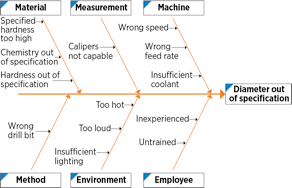
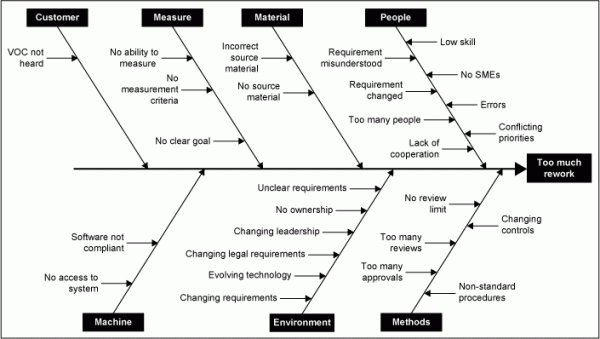
Here is an example of a completed fishbone diagram, showing information entered for each of the four categories agreed upon by this team. Note, as each category is explored, teams may not always identify problems in each of the categories.
Global web icon
mass.edu
https://www.doe.mass.edu/turnaround/level4/root-ca…
Root Cause Analysis Protocol: Fishbone
RCA involves investigating patterns of negative effects, finding in-depth challenges/problems of the system, and discovering specific actions contributing to the challenge/problem. This often means that RCA reveals more than one potential root cause. There are two fishbone diagrams to use with this protocol.
Global web icon
kellyperryconsulting.com
https://www.kellyperryconsulting.com/blog/fishbone…
How to Use a Fishbone Diagram for Root Cause Analysis — Kelly Perry ...
Learn how to use a Fishbone (Ishikawa) Diagram to help identify the root causes of business problems with this simple, step-by-step example and template.
Global web icon
internalauditcollective.com
https://www.internalauditcollective.com/blog/how-t…
How to Use a Fishbone Diagram for Multifactor Root Cause Analysis
THE FRAMEWORK: The Fishbone Diagram for Root Cause Analysis Fishbone diagrams — aka Ishikawa diagrams — are, as Pat articulated, “a visual way of organizing possible causes into logical categories. Instead of following a single chain of whys, this tool is designed for situations where there are likely multiple contributing factors at play.”
Global web icon
lean-corp.com
https://www.lean-corp.com/post/fishbone-diagrams-i…
Fishbone Diagrams in Quality Management: A Beginner’s Guide to Root ...
To truly solve issues and prevent them from recurring, we must identify their root causes—and that’s where the Fishbone Diagram, also known as the Ishikawa Diagram or Cause-and-Effect Diagram, becomes an essential tool.
Global web icon
leanoutsidethebox.com
https://leanoutsidethebox.com/ishikawa-fishbone-di…
Ishikawa Fishbone Diagrams: A Proven Method for Problem-Solving
Ishikawa fishbone diagrams, also known as cause-and-effect diagrams or fishbone charts, are powerful tools for problem-solving and quality management. Developed by Kaoru Ishikawa in the 1960s, these diagrams help teams identify, organize, and analyze potential causes of problems in various processes.
Global web icon
remotesparks.com
https://www.remotesparks.com/examples-of-cause-and…
8 Practical Examples of Cause and Effect Diagrams for 2025
Explore 8 real-world examples of cause and effect diagrams. See how fishbone (Ishikawa) diagrams solve problems in manufacturing, healthcare, and software.
Global web icon
strategicleadersconsulting.com
https://strategicleadersconsulting.com/how-can-a-f…
How Can a Fishbone Diagram Be Used in Root Cause Analysis?
Utilize the Fishbone Diagram to dissect and categorize complexities in root cause analysis effectively. Identify problem categories and map out causes systematically under People, Machine, Method, Measurement, Material, and Environment. Prioritize causes by impact, emphasizing critical factors first.
Global web icon
goleansixsigma.com
https://goleansixsigma.com/fishbone-diagram/
Fishbone Diagram: Finding the Root Cause of a Problem
Like a medical diagnosis, a Fishbone Diagram systematically analyzes symptoms to pinpoint the underlying cause of a condition. The Fishbone Diagram is a visual tool used in Lean Six Sigma (LSS) methodology to identify and categorize potential causes of a problem.
Global web icon
isixsigma.com
https://www.isixsigma.com/dictionary/fishbone-diag…
Fishbone Diagrams: A Powerful Tool for Root Cause Analysis
Affinity diagrams are used to do a high-level organization of the ideas and the fishbone diagram is used to drill down and do root cause analysis. This is typically done in the Analyze phase of the Six Sigma DMAIC process. Overview: What Is a Fishbone Diagram?
Global web icon
kaizen.com
https://kaizen.com/insights/ishikawa-diagram-root-…
Understanding the Ishikawa Diagram | KAIZEN™ Article
In this article, we explore what the Ishikawa Diagram is, how it works, its importance in root cause analysis, and how it can be integrated into other problem-solving tools. What is an Ishikawa diagram?
Global web icon
quality-one.com
https://quality-one.com/rca/root-cause-analysis-an…
Root Cause Analysis and Fishbone Diagrams - Quality-One
Root Cause Analysis (RCA) is a systematic approach used to identify the underlying causes of problems or failures within an organization. One of the most powerful tools used within RCA is the Fishbone Diagram, also known as the Ishikawa Diagram or Cause-and-Effect Diagram.
Global web icon
leandatapoint.com
https://leandatapoint.com/resources/fishbone-diagr…
Ishikawa Fishbone Diagram for Root Cause Analysis (RCA) - LTS
What is a Fishbone Diagram? A Fishbone Diagram, also known as an Ishikawa Diagram or Cause-and-Effect Diagram, is a quality tool that helps users identify the many possible causes for a problem by sorting ideas into useful categories.
Global web icon
learnleansigma.com
https://www.learnleansigma.com/guides/fishbone-dia…
Guide: Fishbone Diagram - Learn Lean Sigma
Fishbone diagrams, or Ishikawa cause-and-effect charts, visually organise potential root causes into themed branches, guiding teams past gut guesses to evidence-based fixes that eliminate defects, downtime, and recurring quality headaches.
Global web icon
rzsoftware.com
https://rzsoftware.com/fishbone-analysis/
Fishbone Analysis Guide | Redzone Software
This is where Fishbone Analysis, also known as the Ishikawa Diagram or Cause-and-Effect Diagram, plays a critical role. It’s a structured root cause analysis (RCA) tool designed to dissect complex issues methodically and trace them back to their origin.
Global web icon
lacounty.gov
https://publichealth.lacounty.gov/qiap/docs/Topic3…
Fishbone Diagram & The 5 Whys - LA County Department of Public Health
A technique developed by Sakichi Toyoda to uncover the cause and effect relationships a problem and determine the problem’s root cause to help identify the solution. A detailed questioning process designed to drill down into the details of a problem and peel away the “symptoms.” The 5 Whys – When do we use it? The 5 Whys – How is it used?
Global web icon
creately.com
https://creately.com/guides/types-of-fishbone-diag…
The 4 Key Types of Fishbone Diagrams with Examples | Creately
In this guide, we’ll walk through the most common types of fishbone diagrams, explain how they work, and provide real-world examples to help you apply them effectively. A Fishbone Diagram, also known as an Ishikawa or Cause-and-Effect Diagram, helps identify the root cause of a problem.
Global web icon
vatix.com
https://www.vatix.com/blog/fishbone-diagram
How to Use a Fishbone Diagram for Root Cause Analysis - Vatix
Let's walk through the steps to create a fishbone diagram for root cause analysis: 1. Define the problem statement. The first step in creating a fishbone diagram is to clearly define the problem statement. This is the "head" of the fish, and it should be a concise description of the issue you're trying to solve.
Global web icon
thepowerscompany.com
https://www.thepowerscompany.com/resources/fishbon…
Mastering Root Cause Analysis: Utilizing the Fishbone Diagram to Boost ...
What is a Fishbone Diagram? The Fishbone Diagram, also known as the Ishikawa Diagram or Cause-and-Effect Diagram, is a powerful tool for root cause analysis in manufacturing.
Global web icon
purplegriffon.com
https://purplegriffon.com/blog/fishbone-diagram-is…
Fishbone Diagram | Purple Griffon
What is a Fishbone Diagram? A Fishbone Diagram, also known as an Ishikawa diagram or a cause-and-effect diagram, is a visual tool used for systematic problem-solving and root cause analysis. It helps teams categorise and visualise the different potential causes of a problem to identify its root causes.
Global web icon
aeanet.org
https://www.aeanet.org/how-to-make-a-fishbone-diag…
How to Make a Fishbone Diagram in Excel? - AEANET
Understanding the Fishbone Diagram The fishbone diagram, also known as the Ishikawa diagram or cause-and-effect diagram, is a visual tool used to identify potential causes of a specific problem or effect. It’s a staple in quality control, problem-solving, and root cause analysis.
Global web icon
wikipedia.org
https://en.wikipedia.org/wiki/Root-cause_analysis
Root-cause analysis - Wikipedia
A word of caution: Ishikawa or the Fishbone Diagram, and the 5-Whys methods, are not rigorous enough for conducting a root-cause analysis. The Fishbone is from the 1940s and the 5-Whys is from the 1930, and there are much more advanced methods available.
Global web icon
gainsystems.com
https://gainsystems.com/blog/4-ways-root-cause-ana…
Root Cause Analysis Supply Chain: 4 Steps Most Companies Skip (But ...
The Fishbone Diagram, also called the Ishikawa Diagram, is another RCA method for identifying supply chain root causes. Often used in manufacturing and product development, it visually categorizes possible causes of a problem.
Global web icon
neogen.com
https://www.neogen.com/en/usac/neocenter/blog/guid…
8 Step Guide to Root Cause Analysis for Food Safety Teams
Learn the steps of Root Cause Analysis for food safety teams and how to apply this structured method to strengthen your environmental monitoring program.
Global web icon
xtensio.com
https://xtensio.com/how-to-do-root-cause-analysis/
How to Do Root Cause Analysis: 6 Steps & Examples | Xtensio
Understanding Root Cause Analysis: Dive deeper into the principles and practices of RCA with this comprehensive guide from American Society for Quality (ASQ). Practical RCA Tools and Techniques: Explore different RCA tools, such as the 5 Whys and Fishbone Diagram, and their applications at MindTools.
Global web icon
easyrca.com
https://easyrca.com/blog/the-ultimate-guide-to-cho…
The Ultimate Guide to Choosing the Right Root Cause Analysis Software ...
What is Root Cause Analysis software? Software designed to streamline, document, and standardize problem-solving using methods such as 5-Why, fishbone, or logic trees.
Global web icon
priz.guru
https://www.priz.guru/root-cause-analysis-for-cont…
Root Cause Analysis for Continuous Improvement | PRIZ Guru
Learn how root cause analysis drives continuous improvement in Lean manufacturing, supports Kaizen culture, and PRIZ Guru helps teams track RCA over time.